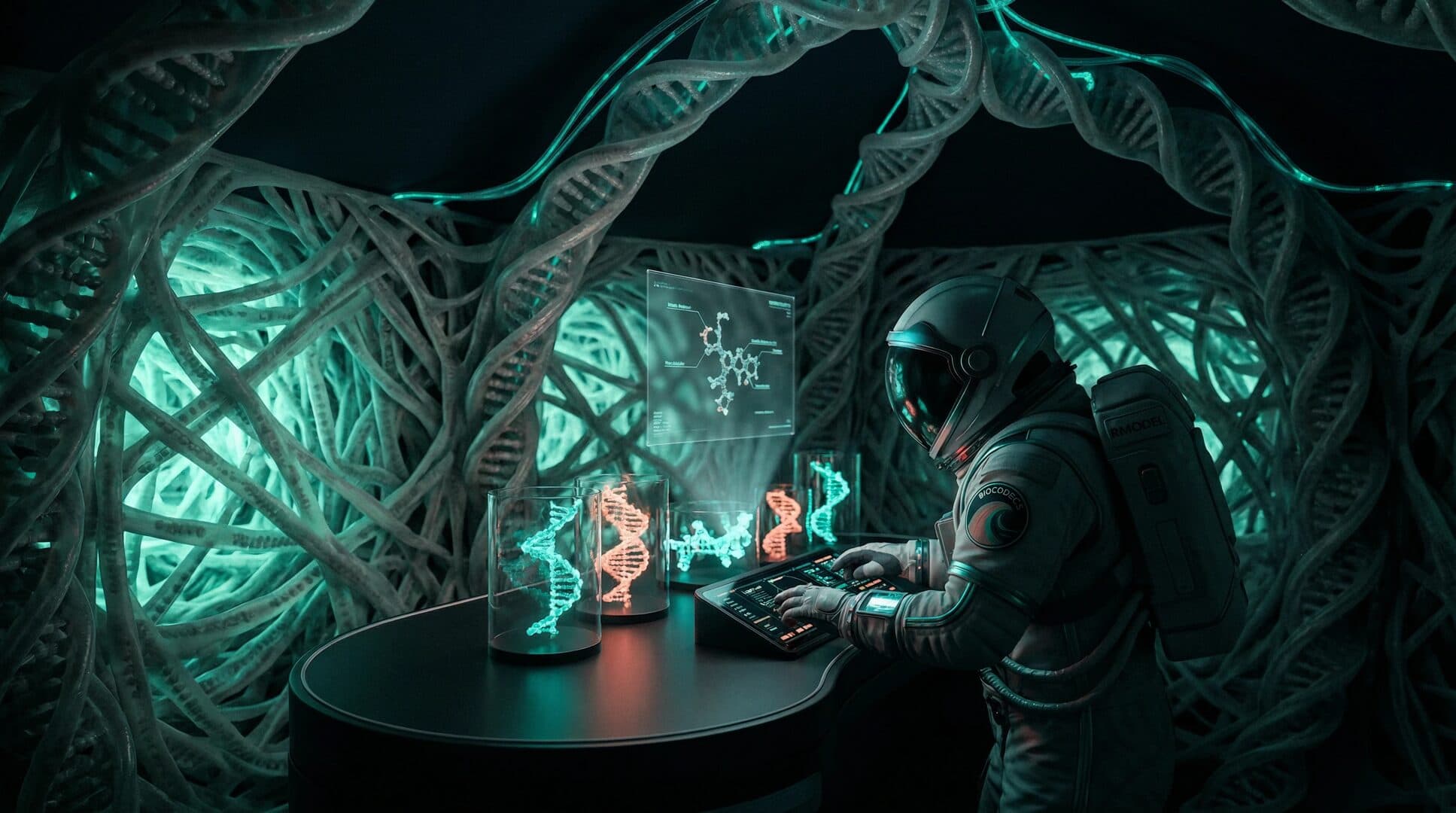
RNA Modifications & Epitranscriptome
What happens when the cell edits its own genetic messages after they're written?
In Simple Terms
After a genetic message is copied out, the cell can still decorate it with tiny chemical marks. These marks do not change the underlying letters, but they change how the message behaves: how long it survives, how it is folded, and how readily it is turned into protein. This extra layer of information is called the epitranscriptome. It is one way a cell fine tunes itself without rewriting its genes, and it shifts during development, stress and disease. The marks are small and were long invisible, so we build methods that can read them, one molecule at a time, across an entire transcriptome.
The Science
We detect and interpret RNA modifications directly from Oxford Nanopore direct RNA sequencing, which reads native RNA molecules whole rather than as short reconstructed fragments. Using deep-learning detectors such as CHEUI we call m6A and m5C at single-molecule resolution and measure their co-occurrence across the transcriptome, while SWARM resolves signal interference between different modification types so that overlapping marks can be told apart. This lets us map modifications to individual isoforms, relate them to splicing and to translational output, and follow how the modification landscape is remodelled between conditions and across evolution.
Team







Key Publications
Prediction of m6A and m5C at single-molecule resolution reveals a transcriptome-wide co-occurrence of RNA modifications
Acera Mateos, P; J Sethi, A; Ravindran, A; Srivastava, A; Woodward, K; Mahmud, S; Kanchi, M; Guarnacci, M; Xu, J; WS Yuen, Z
Nature Communications 15(1), 3899
SWARM resolves nanopore signal interference between RNA modification types and reveals splicing-shaped pseudouridylation
S Prodic, A Cleynen, S Mahmud, A Srivastava, A Ravindran, M Kanchi, ...
bioRxiv 2025.12.18.695332
Isoform-specific m6A deposition and coordinated splicing shape mammalian transcriptome evolution
Santos-Rodriguez, Gabriela; Srivastava, Akanksha; Ravindran, Agin; Oyelami, Favour O; Ip, Chi Kin; Gupta, Pallavi; Villanueva, Jeanette; King, Helen E; Grootveld, Abigail; Sneddon, Alexandra
Nature Communications
Substrate diversity of NSUN enzymes and links of 5-methylcytosine to mRNA translation and turnover
Guarnacci, Marco; Zhang, Pei-Hong; Kanchi, Madhu; Hung, Yu-Ting; Lin, Hanrong; Shirokikh, Nikolay E; Yang, Li; Preiss, Thomas
Life science alliance 7(9)